So, I’m a low church Baptist whose largest missiological work is a novel about dreams and a dragon, and I get to preach on Revelation today. What could possibly go wrong?
Soon after my conversion in college, I came across a book that linked the Gulf War to predictions in the Bible. I don’t want to get too specific, but the title included “Armageddon, Oil, and the Middle East Crisis.” It could be anything. I admit that I was originally fascinated and somewhat persuaded. It didn’t take too long, though, before I became very skeptical of the latest voices using Revelation to make modern day predictions. Little did I know that the book I just mentioned was originally written in 1974, updated for the Gulf War, and revised and resold again after 9/11.
This text is from a sermon at Beeson Divinity, Spring 2025
It’s one thing to have a healthy skepticism of predictions that always revolve around America and the exact time in which we live, which is very convenient for us. It’s another to see Revelation for what it is. One of the critiques of the book I mentioned above gets to the point. He writes: “The authors completely ignore the life of Jesus and the significance of his words, “follow me.” Not one line of this book is concerned with how one should live in the light of Jesus’ coming.”
It’s one thing to develop a healthy skepticism of predictions based on Revelation. That’s easy enough. You just need to either study history or live long enough to watch them not come true. It’s another thing to realize that when we look to Revelation simply as a key to predict future events on earth before the return of Christ and the New Creation, we’re actually missing the main point. And that was a longer journey for me. Let’s jump in.
Revelation 7:9: “After this.” Okay, we have to stop already. This is like Paul’s “therefore.” You have to stop and ask, “What’s it there for?” There’s so much that’s happened already, so let’s sum up the early chapters.
God gave John a message and a vision. As Paul Spilsbury explains how to read Revelation, he emphasizes that, while it’s true that God gave John the vision, we actually don’t have direct access to the vision. We can’t literally see what John saw. What we do have access to are his descriptions of the vision, which he crafted in specific ways. Like the OT prophets before him, he’s straining to describe what he saw in ways that could be understood for his readers.
The first three chapters of Revelation begin with John receiving a message from Jesus to give to the 7 churches: Ephesus, Smyrna, Pergamum, Thyatira, Sardis, Philadelphia, and Laodicea. The messages are specific to each church and are a combination of praise, rebuke, warnings of judgment for sins ranging from sexual immorality to simply being lukewarm in their faith, and an encouragement to live faithfully in their present lives in the Roman Empire in light of the eternal promises of the kingdom of God and the New Creation. That’s a very brief summary, but it’s necessary to set the tone of the letter. Now we turn to chapter four, which is actually the beginning of the throne room scene of our primary passage in chapter 7. And by any standard you choose… IT. IS. WILD.
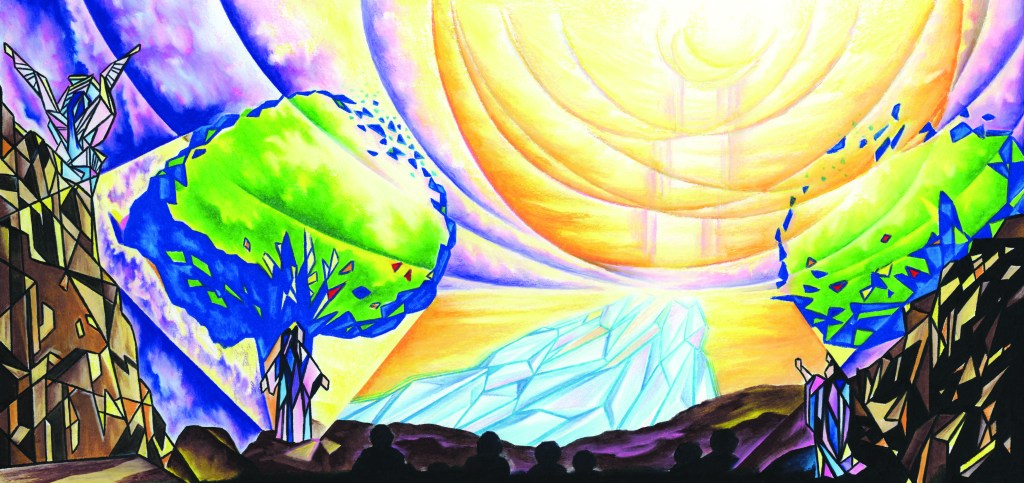
At once I was in the Spirit, and behold, a throne stood in heaven, with one seated on the throne. 3 And he who sat there had the appearance of jasper and carnelian, and around the throne was a rainbow that had the appearance of an emerald. 4 Around the throne were twenty-four thrones, and seated on the thrones were twenty-four elders, clothed in white garments, with golden crowns on their heads. 5 From the throne came flashes of lightning, and rumblings and peals of thunder, and before the throne were burning seven torches of fire, which are the seven spirits of God, 6 and before the throne there was as it were a sea of glass, like crystal. And around the throne, on each side of the throne, are four living creatures, full of eyes in front and behind: 7 the first living creature like a lion, the second living creature like an ox, the third living creature with the face of a man, and the fourth living creature like an eagle in flight. 8 And the four living creatures, each of them with six wings, are full of eyes all around and within, and day and night they never cease to say, “Holy, holy, holy, is the Lord God Almighty, was was and is and is to come!” (Revelation 4:2-8, ESV).
A few comments before moving on. I don’t want to get bogged down with the details, especially since some of them are debated among scholars, but we’ll need to address the twenty-four elders and the four creatures worshiping the Lord. I’m not the smartest guy employed by Beeson Divinity School, but I figured I should probably consult Dr. Thielman for some of this, and if you disagree, he’s right over there. Dr. Thielman believes that the elders simply represent the people of God. There’s more to be said on the topic, but for now we’ll leave it at that. He also pointed out to me that the number four is often used as symbolic of the four corners of the earth. And if you get uncomfortable with interpreting things in Revelation as symbolic, I’d like to hear about how you believe Jesus is literally a lamb. Lastly, you may notice that the physical characteristics of the four creatures have a lot in common with the visions of Isaiah (chapter 6) and Ezekiel (chapter 1).
The throne room scene continues with the revelation that there are words sealed up in a scroll, and John weeping loudly because there’s no one worthy to open it. There’s no King Arthur to pull the sword out of the rock. There’s no Captain America to wield Thor’s Hammer. Huh!? You like that? But then we hear the title of one called the “Lion of Judah” and the “root of David.” And just when you expect to see a great soldier… John sees a Lamb instead. A lamb that had apparently been killed but is now standing, which is intimidating in its own way, if you think about it. It’s as if God is using a slain lamb to show how little he is impressed with the powers of this world. And this lamb is worthy to open the scrolls because, by his blood, he has ransomed people from every tribe and people and language and nation.
The scene continues as the scrolls are opened, judgement is proclaimed, and the martyrs who have been killed for their gospel witness are vindicated. Revelation 7 opens with an angel holding back on a particular judgment until the 144,000 are sealed. These are, again, the people of God, with the twelve tribes of Judah serving as the symbol for the Lord’s people. Again, if you have an issue with that, Dr. Thielman is available.
Finally… we are at our passage!
After this] I looked, and behold, a great multitude that no one could number, from every nation, from all tribes and peoples and languages, standing before the throne and before the Lamb, clothed in white robes, with palm branches in their hands, 10 and crying out with a loud voice, “Salvation belongs to our God who sits on the throne, and to the Lamb!” 11 And all the angels were standing around the throne and around the elders and the four living creatures, and they fell on their faces before the throne and worshiped God, 12 saying, “Amen! Blessing and glory and wisdom and thanksgiving and honor and power and might be to our God forever and ever! Amen.” (Revelation 7:9-12)
John records for us an explosive scene. Awe-inspiring worship of the one true God. As some of the first century believers are struggling with the temptations to cozy up to the ways of Rome… and as others are living in fear of this overwhelmingly powerful empire… God is telling them, through this vision… you need to doubt the reality you see with your own eyes. The lifestyles you’re tempted with are nothing compared to the reality of God. As Spilsbury points out, “The power of Rome is nothing compared to the One on the throne.” Dean Flemming, in Foretaste of the Future, draws this theme out throughout his book. He says, “To be sure, some of John’s audience needed to be encouraged in the midst of trial. But for others, John’s messages sounded more like, ‘Wake up! Stop compromising! Turn around or you risk facing God’s judgment!’”
The kingdoms of this world come and go – even Rome. But the real king is forever. The real king came in on a donkey on Palm Sunday, and even though he was betrayed in Jerusalem, in Heaven the palm branches are still waving. He lived a perfect life. Was crucified for our sins. Dead and buried. Resurrected on the third day, and ascended to Heaven where He was and is and is to come. He’s being worshiped by the elders, creatures that are beyond our imagination, and people from every nation.
We shouldn’t miss the fact that the Lamb is worshiped equally with God. (verse 10) “Salvation belongs to our God, who sits on the throne, and to the Lamb!” Two persons of the Trinity are recognized. And everyone is falling on their faces to acknowledge that God is the only true source of blessing, glory, thanksgiving, honor, power, and might – forever!
This isn’t a secret code to help them navigate the rapture. John’s vision is telling first century believers – and is telling us today – “This is reality! The eternal glory of God! The coming New Creation! Make sure that your present life matches up to this reality.”
When Dr. Christopher Wright was here a couple of years ago, he talked about trying to walk Christians through various issues, both cultural and theological. He said that the problem he keeps noticing is not so much that they’re getting the wrong answers. They’re in the wrong story. Now, at this point, some of you are thinking, “You’re just wanting to talk about your Step Into the Story tour in the Global Center.” Yes! Of course! This passage is an alley oop from Dr. Sweeney, who arranged the entire year as a walkthrough of Scripture. Do you really think I’m going to go off script now and try to say something different than “the Bible is one long story of God getting his glory by saving people from every tongue, tribes, and nations?!” This the story we are supposed to be living in. It’s not just the Great Commission. It’s the entire narrative of Scripture. And I want every Christian to know it!
When I lead walkthrough tours of the Global Center displays, I want them to know what the Bible has to say about God’s heart for the nations. So let me take a deep breath here and walk through a much too brief version of it for the sake of time.
It’s a story that begins in a garden, where a perfectly loving God creates man and woman in his image. They enjoy perfect fellowship with God and each other in a beautiful creation they are charged to oversee. But they give in to the lie from the serpent that God is holding out on them, and that he is not to be trusted. As a result, they are exiled from the garden and all of mankind has been infected with this rebellious spirit ever since.
The story includes God calling Abraham and Sarah to pick up and follow him to a land he would show them, that he would make their descendants as numerous as the stars in the sky, and that he would use them to bless all the families of the earth – not just his descendants.
It continues as Moses is leading the people to the land promised to Abraham. While in the desert, God tells Moses that he wants the people to obey his commands, not just because they’re good and holy, but also because he wants the nations to see the righteousness and goodness of his commands and worship him. When Solomon builds the temple, his first prayer is not just for the blessing of the people of Israel. He prays that God would hear the prayers of the foreigners and that all people of the earth would know Yahweh.
But eventually, just as Adam and Eve sinned and were exiled from the garden, the Israelites continue to sin and are exiled from the land. Even so, God gets his glory among the nations. In the book of Daniel, we see the most powerful king in the world, Nebuchadnezzar, so shaken and amazed at the person in the fiery furnace with Shadrach, Meshach, and Abednego, that he glorifies and praises the God of Israel. The prophets during this time speak of the coming Messiah and foretell of an age when people from all tongues, tribes, and nations will gather in Jerusalem.
Then the Messiah comes, both lowly and miraculously born of a virgin. Although most of his life was spent among the Jews, He foretells of a future when those from east and west will come and recline at the table with Abraham, Isaac, and Jacob. He even honors a woman from Samaria by making her among the first to have the theological insight that, one day, we won’t even need a temple. After his death and resurrection, Jesus makes it clear to his disciples that the time has come for them to go the nations to make disciples. And they do, in fact, eventually go out.
As the story continues in Acts, a religious leader who persecuted Christians named Saul is hit with a blinding light, his life is transformed by a gospel that is by grace through faith – not by works so that no one can boast – and he becomes the apostle to the Gentiles as churches are being planted all across the Roman Empire.
Since the first century, the gospel has made its way around the world. It went both east and west in the early years, but for centuries was primarily centered in the West. In 1910, 90% of the world’s Christians were in the Americas and Europe. However, by 2010, only 62% were in the Americas and Europe, with 13% in the Asia/Pacific, and a stunning 24% in sub-Saharan Africa. Philip Jenkins records 10 million African Christians in 1910, and 400 million in 2000. Jesus said in Matthew 24:14 that the gospel will be preached to all nations before the end comes. Revelation confirms that this will come true. And history does nothing but bear witness that it’s true. And if you go downstairs in the Global Center to look at the timeline and scan the QR code (can’t believe I just said that in a sermon).. you’ll get a small glimpse of how the gospel has spread from one people to another throughout history.
Even if you never left Birmingham, this is the story you are in. God getting his glory by disciples being made from every tongue, tribe, and nation.
The last part of the story of Scripture begins with the throne room, where we started today, and continues to reveal a beautiful New Creation, where all things will be made new. Where there is no sin. Where the veil between us and God is forever abolished, and where there are no tears, or suffering, or sin. We will love God and each other perfectly.
What does it mean to live in this story as opposed to another story? I can’t help but think of the recent news report of a man kayaking in the Straits of Magellan, off the coast of Chile. A video seems to confirm the story that Adrian Simoncas was engulfed into the mouth of a whale. When he described the experience, he said the first thing he noticed was how slimy this monster was and then he just started hoping that he would get out of the mouth of the whale, like…. Like… like who? No… he didn’t say Jonah. Pinocchio! He came out with Pinocchio! He had one job! All he had to do was make one corny Jonah joke and he could have named his price for VBS speaking engagements all over the planet! And he said Pinocchio. He had the winning lottery number in his pocket and tossed his jeans in the washer. And he can’t change his story and say he actually thought of Jonah first because people would just look at him and say, “Pinocchio!” How symbolic for us, as a culture, where we’re more familiar with the stories of Disney than the Bible.
The stories we are immersed in come out in the most unexpected ways. They tend to be the most powerful and often the most unconscious influences in our lives. Our stories provide our heroes and tell us who we should, and should not, be like. When we are not immersing ourselves into Scripture, we’ll find other stories and heroes to give us meaning and inspire us. They’ll make grand truth statements that influence our opinions and worldview more than we’d like to admit.
So how do we know if we’re living in the wrong story? I don’t know exactly how to tell you for sure, but here’s a few examples.
A couple of months ago, there were 70 Christians in the Democratic Republic of the Congo who were rounded up and beheaded by Islamic militants, according to Open Doors and many other reliable sources. Unless you have alternative news feeds, you didn’t hear about it because most of the major news outlets don’t want to be accused of being Islamaphobic. Our vision inside the throne room of God in Revelation includes a vindication of those killed for their faith. They are given significant “air time” in Revelation – and it is clear that God wants to honor them. You see, it’s easy to talk about yesterday’s martyrs. It’s talking about today’s martyrs that always becomes complicated. If you find yourself avoiding talking about our brothers and sisters being martyred today because you don’t want to be seen as Islamaphobic, you’re in the wrong story. “But David, not all Muslims are violent!” I know that. I’ve lived in two Muslim countries. But which made you more anxious? The 70 brothers and sisters who were killed? Or a possible misperception of Christianity that you would find embarrassing? Our brothers and sisters in Christ in other parts of the world are sometimes perplexed about how afraid we are to speak for them.
If you come to chapter seven and you’re excited to see a diversity of peoples, but less excited about the fact that there’s only one God and you’re low key embarrassed about the consistent judgment of sexual immorality throughout Revelation, you’re in the wrong story. You’re in the postmodern story that says there is no ultimate truth, so don’t judge or say things that are deemed offensive and you can be declared acceptable. This passage is not a “celebration of diversity for the sake of diversity.” This is the one true God shutting up every lie that’s ever been told – any untruth that diminishes his glory – and getting the glory due him by graciously saving people created in His image from all tongues, tribes, and nations.
On the other hand, if you come to this passage and you want to downplay the intentionality of John recording that there are people from every ethnicity imaginable because feels like political correctness and multiculturalism… you’re in the wrong story. If you’re so frustrated about political issues that you can’t love the Muslim, Buddhist, Hindu, or even worse, the liberal, in front of you… you’re in the wrong story.
To Beeson students. I love you. I believe you are some of the best of the best. I’m praying God uses you for his glory in ways I don’t know to pray for. Be careful you don’t fall for the modernized story that says, “Yes, I’ll follow God into the ministry. I’ll take that step of faith. But only if I can see a clear career path that allows me to live with all the comforts I’m used to, in places I’m used to, and fits perfectly within my Enneagram number.
In 2020 I went as deeply as possible into the Beeson alumni list to see what percentage of Beeson students had entered into cross-cultural missions. A generous count came up with 4%. Most people in the world will be called to stay and minister among their own people. No one should feel guilty for that. But when churches and seminaries take a step back, we should be realistic about whether or not we are sending seminaries and churches. We may or may not be over the 4% now. I don’t know. But I want to challenge you to consider the call to go to the billions who have no access to the gospel, and know no believers. Consider the call to use the theological training you’re receiving to go and raise up leaders in places where there are many Christians, but they have little to no access to biblical training. I want to challenge each of you to spend some time picturing yourself around the throne of God. And, in light of eternity, ask God how you would spend your life most wisely.
And finally, for anyone who may hear this sermon… If you find yourself consistently with your Bible open to Revelation – cable news screaming in the background, or glued to an apocalyptic social media feed – trying to use the Bible like a tarot card reading to tell the immediate future, you’re missing the point of Revelation. God doesn’t want us to sit around, constantly fretting about how it’s all going to fall apart. He wants to give us courage to live out the Great Commission in the here and now – with the comfort of knowing He’s going to put it all back together. He wants us to step into the story of Scripture. It’s a hopeful story. May we cling to it.
I look forward to next week, as we hear about God’s promise that awaits us in the New Creation.
 David Parks