Category: Biblical Basis for Missions

  • Step Into The Story

    Step Into The Story

    So, I’m a low church Baptist whose largest missiological work is a novel about dreams and a dragon, and I get to preach on Revelation today. What could possibly go wrong?

    Soon after my conversion in college, I came across a book that linked the Gulf War to predictions in the Bible. I don’t want to get too specific, but the title included “Armageddon, Oil, and the Middle East Crisis.” It could be anything. I admit that I was originally fascinated and somewhat persuaded. It didn’t take too long, though, before I became very skeptical of the latest voices using Revelation to make modern day predictions. Little did I know that the book I just mentioned was originally written in 1974, updated for the Gulf War, and revised and resold again after 9/11.

                   This text is from a sermon at Beeson Divinity, Spring 2025

    It’s one thing to have a healthy skepticism of predictions that always revolve around America and the exact time in which we live, which is very convenient for us. It’s another to see Revelation for what it is. One of the critiques of the book I mentioned above gets to the point. He writes: “The authors completely ignore the life of Jesus and the significance of his words, “follow me.” Not one line of this book is concerned with how one should live in the light of Jesus’ coming.”

    It’s one thing to develop a healthy skepticism of predictions based on Revelation. That’s easy enough. You just need to either study history or live long enough to watch them not come true. It’s another thing to realize that when we look to Revelation simply as a key to predict future events on earth before the return of Christ and the New Creation, we’re actually missing the main point. And that was a longer journey for me. Let’s jump in.

    Revelation 7:9: “After this.” Okay, we have to stop already. This is like Paul’s “therefore.” You have to stop and ask, “What’s it there for?” There’s so much that’s happened already, so let’s sum up the early chapters.

    God gave John a message and a vision. As Paul Spilsbury explains how to read Revelation, he emphasizes that, while it’s true that God gave John the vision, we actually don’t have direct access to the vision. We can’t literally see what John saw. What we do have access to are his descriptions of the vision, which he crafted in specific ways. Like the OT prophets before him, he’s straining to describe what he saw in ways that could be understood for his readers.

    The first three chapters of Revelation begin with John receiving a message from Jesus to give to the 7 churches: Ephesus, Smyrna, Pergamum, Thyatira, Sardis, Philadelphia, and Laodicea. The messages are specific to each church and are a combination of praise, rebuke, warnings of judgment for sins ranging from sexual immorality to simply being lukewarm in their faith, and an encouragement to live faithfully in their present lives in the Roman Empire in light of the eternal promises of the kingdom of God and the New Creation. That’s a very brief summary, but it’s necessary to set the tone of the letter. Now we turn to chapter four, which is actually the beginning of the throne room scene of our primary passage in chapter 7. And by any standard you choose… IT. IS. WILD.

    At once I was in the Spirit, and behold, a throne stood in heaven, with one seated on the throne. 3 And he who sat there had the appearance of jasper and carnelian, and around the throne was a rainbow that had the appearance of an emerald. 4 Around the throne were twenty-four thrones, and seated on the thrones were twenty-four elders, clothed in white garments, with golden crowns on their heads. 5 From the throne came flashes of lightning, and rumblings and peals of thunder, and before the throne were burning seven torches of fire, which are the seven spirits of God, 6 and before the throne there was as it were a sea of glass, like crystal. And around the throne, on each side of the throne, are four living creatures, full of eyes in front and behind: 7 the first living creature like a lion, the second living creature like an ox, the third living creature with the face of a man, and the fourth living creature like an eagle in flight. 8 And the four living creatures, each of them with six wings, are full of eyes all around and within, and day and night they never cease to say, “Holy, holy, holy, is the Lord God Almighty, was was and is and is to come!” (Revelation 4:2-8, ESV).

    A few comments before moving on. I don’t want to get bogged down with the details, especially since some of them are debated among scholars, but we’ll need to address the twenty-four elders and the four creatures worshiping the Lord. I’m not the smartest guy employed by Beeson Divinity School, but I figured I should probably consult Dr. Thielman for some of this, and if you disagree, he’s right over there. Dr. Thielman believes that the elders simply represent the people of God. There’s more to be said on the topic, but for now we’ll leave it at that. He also pointed out to me that the number four is often used as symbolic of the four corners of the earth. And if you get uncomfortable with interpreting things in Revelation as symbolic, I’d like to hear about how you believe Jesus is literally a lamb. Lastly, you may notice that the physical characteristics of the four creatures have a lot in common with the visions of Isaiah (chapter 6) and Ezekiel (chapter 1).

    The throne room scene continues with the revelation that there are words sealed up in a scroll, and John weeping loudly because there’s no one worthy to open it. There’s no King Arthur to pull the sword out of the rock. There’s no Captain America to wield Thor’s Hammer. Huh!? You like that? But then we hear the title of one called the “Lion of Judah” and the “root of David.” And just when you expect to see a great soldier… John sees a Lamb instead. A lamb that had apparently been killed but is now standing, which is intimidating in its own way, if you think about it. It’s as if God is using a slain lamb to show how little he is impressed with the powers of this world. And this lamb is worthy to open the scrolls because, by his blood, he has ransomed people from every tribe and people and language and nation.

    The scene continues as the scrolls are opened, judgement is proclaimed, and the martyrs who have been killed for their gospel witness are vindicated. Revelation 7 opens with an angel holding back on a particular judgment until the 144,000 are sealed. These are, again, the people of God, with the twelve tribes of Judah serving as the symbol for the Lord’s people. Again, if you have an issue with that, Dr. Thielman is available.

    Finally… we are at our passage!

     After this] I looked, and behold, a great multitude that no one could number, from every nation, from all tribes and peoples and languages, standing before the throne and before the Lamb, clothed in white robes, with palm branches in their hands, 10 and crying out with a loud voice, “Salvation belongs to our God who sits on the throne, and to the Lamb!” 11 And all the angels were standing around the throne and around the elders and the four living creatures, and they fell on their faces before the throne and worshiped God, 12 saying, “Amen! Blessing and glory and wisdom and thanksgiving and honor and power and might be to our God forever and ever! Amen.” (Revelation 7:9-12)

    John records for us an explosive scene. Awe-inspiring worship of the one true God. As some of the first century believers are struggling with the temptations to cozy up to the ways of Rome… and as others are living in fear of this overwhelmingly powerful empire… God is telling them, through this vision… you need to doubt the reality you see with your own eyes. The lifestyles you’re tempted with are nothing compared to the reality of God. As Spilsbury points out, “The power of Rome is nothing compared to the One on the throne.” Dean Flemming, in Foretaste of the Future, draws this theme out throughout his book. He says, “To be sure, some of John’s audience needed to be encouraged in the midst of trial. But for others, John’s messages sounded more like, ‘Wake up! Stop compromising! Turn around or you risk facing God’s judgment!’”

    The kingdoms of this world come and go – even Rome. But the real king is forever. The real king came in on a donkey on Palm Sunday, and even though he was betrayed in Jerusalem, in Heaven the palm branches are still waving. He lived a perfect life. Was crucified for our sins. Dead and buried. Resurrected on the third day, and ascended to Heaven where He was and is and is to come. He’s being worshiped by the elders, creatures that are beyond our imagination, and people from every nation.

    We shouldn’t miss the fact that the Lamb is worshiped equally with God. (verse 10) “Salvation belongs to our God, who sits on the throne, and to the Lamb!” Two persons of the Trinity are recognized. And everyone is falling on their faces to acknowledge that God is the only true source of blessing, glory, thanksgiving, honor, power, and might – forever!

    This isn’t a secret code to help them navigate the rapture. John’s vision is telling first century believers – and is telling us today – “This is reality! The eternal glory of God! The coming New Creation! Make sure that your present life matches up to this reality.”

    When Dr. Christopher Wright was here a couple of years ago, he talked about trying to walk Christians through various issues, both cultural and theological. He said that the problem he keeps noticing is not so much that they’re getting the wrong answers. They’re in the wrong story. Now, at this point, some of you are thinking, “You’re just wanting to talk about your Step Into the Story tour in the Global Center.” Yes! Of course! This passage is an alley oop from Dr. Sweeney, who arranged the entire year as a walkthrough of Scripture. Do you really think I’m going to go off script now and try to say something different than “the Bible is one long story of God getting his glory by saving people from every tongue, tribes, and nations?!” This the story we are supposed to be living in. It’s not just the Great Commission. It’s the entire narrative of Scripture. And I want every Christian to know it!

     When I lead walkthrough tours of the Global Center displays, I want them to know what the Bible has to say about God’s heart for the nations. So let me take a deep breath here and walk through a much too brief version of it for the sake of time.

     It’s a story that begins in a garden, where a perfectly loving God creates man and woman in his image. They enjoy perfect fellowship with God and each other in a beautiful creation they are charged to oversee. But they give in to the lie from the serpent that God is holding out on them, and that he is not to be trusted. As a result, they are exiled from the garden and all of mankind has been infected with this rebellious spirit ever since.

    The story includes God calling Abraham and Sarah to pick up and follow him to a land he would show them, that he would make their descendants as numerous as the stars in the sky, and that he would use them to bless all the families of the earth – not just his descendants.

     It continues as Moses is leading the people to the land promised to Abraham. While in the desert, God tells Moses that he wants the people to obey his commands, not just because they’re good and holy, but also because he wants the nations to see the righteousness and goodness of his commands and worship him. When Solomon builds the temple, his first prayer is not just for the blessing of the people of Israel. He prays that God would hear the prayers of the foreigners and that all people of the earth would know Yahweh.

     But eventually, just as Adam and Eve sinned and were exiled from the garden, the Israelites continue to sin and are exiled from the land. Even so, God gets his glory among the nations. In the book of Daniel, we see the most powerful king in the world, Nebuchadnezzar, so shaken and amazed at the person in the fiery furnace with Shadrach, Meshach, and Abednego, that he glorifies and praises the God of Israel. The prophets during this time speak of the coming Messiah and foretell of an age when people from all tongues, tribes, and nations will gather in Jerusalem.

    Then the Messiah comes, both lowly and miraculously born of a virgin. Although most of his life was spent among the Jews, He foretells of a future when those from east and west will come and recline at the table with Abraham, Isaac, and Jacob. He even honors a woman from Samaria by making her among the first to have the theological insight that, one day, we won’t even need a temple. After his death and resurrection, Jesus makes it clear to his disciples that the time has come for them to go the nations to make disciples. And they do, in fact, eventually go out.

    As the story continues in Acts, a religious leader who persecuted Christians named Saul is hit with a blinding light, his life is transformed by a gospel that is by grace through faith – not by works so that no one can boast – and he becomes the apostle to the Gentiles as churches are being planted all across the Roman Empire.

    Since the first century, the gospel has made its way around the world. It went both east and west in the early years, but for centuries was primarily centered in the West. In 1910, 90% of the world’s Christians were in the Americas and Europe. However, by 2010, only 62% were in the Americas and Europe, with 13% in the Asia/Pacific, and a stunning 24% in sub-Saharan Africa. Philip Jenkins records 10 million African Christians in 1910, and 400 million in 2000. Jesus said in Matthew 24:14 that the gospel will be preached to all nations before the end comes. Revelation confirms that this will come true. And history does nothing but bear witness that it’s true. And if you go downstairs in the Global Center to look at the timeline and scan the QR code (can’t believe I just said that in a sermon).. you’ll get a small glimpse of how the gospel has spread from one people to another throughout history.

    Even if you never left Birmingham, this is the story you are in. God getting his glory by disciples being made from every tongue, tribe, and nation.

    The last part of the story of Scripture begins with the throne room, where we started today, and continues to reveal a beautiful New Creation, where all things will be made new. Where there is no sin. Where the veil between us and God is forever abolished, and where there are no tears, or suffering, or sin. We will love God and each other perfectly.

    What does it mean to live in this story as opposed to another story? I can’t help but think of the recent news report of a man kayaking in the Straits of Magellan, off the coast of Chile. A video seems to confirm the story that Adrian Simoncas was engulfed into the mouth of a whale. When he described the experience, he said the first thing he noticed was how slimy this monster was and then he just started hoping that he would get out of the mouth of the whale, like…. Like… like who? No… he didn’t say Jonah. Pinocchio! He came out with Pinocchio! He had one job! All he had to do was make one corny Jonah joke and he could have named his price for VBS speaking engagements all over the planet! And he said Pinocchio. He had the winning lottery number in his pocket and tossed his jeans in the washer. And he can’t change his story and say he actually thought of Jonah first because people would just look at him and say, “Pinocchio!” How symbolic for us, as a culture, where we’re more familiar with the stories of Disney than the Bible.

    The stories we are immersed in come out in the most unexpected ways. They tend to be the most powerful and often the most unconscious influences in our lives. Our stories provide our heroes and tell us who we should, and should not, be like. When we are not immersing ourselves into Scripture, we’ll find other stories and heroes to give us meaning and inspire us. They’ll make grand truth statements that influence our opinions and worldview more than we’d like to admit.

    So how do we know if we’re living in the wrong story? I don’t know exactly how to tell you for sure, but here’s a few examples.

    A couple of months ago, there were 70 Christians in the Democratic Republic of the Congo who were rounded up and beheaded by Islamic militants, according to Open Doors and many other reliable sources. Unless you have alternative news feeds, you didn’t hear about it because most of the major news outlets don’t want to be accused of being Islamaphobic. Our vision inside the throne room of God in Revelation includes a vindication of those killed for their faith. They are given significant “air time” in Revelation –  and it is clear that God wants to honor them. You see, it’s easy to talk about yesterday’s martyrs. It’s talking about today’s martyrs that always becomes complicated. If you find yourself avoiding talking about our brothers and sisters being martyred today because you don’t want to be seen as Islamaphobic, you’re in the wrong story. “But David, not all Muslims are violent!” I know that. I’ve lived in two Muslim countries. But which made you more anxious? The 70 brothers and sisters who were killed? Or a possible misperception of Christianity that you would find embarrassing? Our brothers and sisters in Christ in other parts of the world are sometimes perplexed about how afraid we are to speak for them.

    If you come to chapter seven and you’re excited to see a diversity of peoples, but less excited about the fact that there’s only one God and you’re low key embarrassed about the consistent judgment of sexual immorality throughout Revelation, you’re in the wrong story. You’re in the postmodern story that says there is no ultimate truth, so don’t judge or say things that are deemed offensive and you can be declared acceptable. This passage is not a “celebration of diversity for the sake of diversity.” This is the one true God shutting up every lie that’s ever been told – any untruth that diminishes his glory – and getting the glory due him by graciously saving people created in His image from all tongues, tribes, and nations.  

    On the other hand, if you come to this passage and you want to downplay the intentionality of John recording that there are people from every ethnicity imaginable because feels like political correctness and multiculturalism… you’re in the wrong story. If you’re so frustrated about political issues that you can’t love the Muslim, Buddhist, Hindu, or even worse, the liberal, in front of you… you’re in the wrong story.

    To Beeson students. I love you. I believe you are some of the best of the best. I’m praying God uses you for his glory in ways I don’t know to pray for. Be careful you don’t fall for the modernized story that says, “Yes, I’ll follow God into the ministry. I’ll take that step of faith. But only if I can see a clear career path that allows me to live with all the comforts I’m used to, in places I’m used to, and fits perfectly within my Enneagram number.

    In 2020 I went as deeply as possible into the Beeson alumni list to see what percentage of Beeson students had entered into cross-cultural missions. A generous count came up with 4%. Most people in the world will be called to stay and minister among their own people. No one should feel guilty for that. But when churches and seminaries take a step back, we should be realistic about whether or not we are sending seminaries and churches. We may or may not be over the 4% now. I don’t know. But I want to challenge you to consider the call to go to the billions who have no access to the gospel, and know no believers. Consider the call to use the theological training you’re receiving to go and raise up leaders in places where there are many Christians, but they have little to no access to biblical training. I want to challenge each of you to spend some time picturing yourself around the throne of God. And, in light of eternity, ask God how you would spend your life most wisely.

    And finally, for anyone who may hear this sermon… If you find yourself consistently with your Bible open to Revelation – cable news screaming in the background, or glued to an apocalyptic social media feed – trying to use the Bible like a tarot card reading to tell the immediate future, you’re missing the point of Revelation. God doesn’t want us to sit around, constantly fretting about how it’s all going to fall apart. He wants to give us courage to live out the Great Commission in the here and now – with the comfort of knowing He’s going to put it all back together. He wants us to step into the story of Scripture. It’s a hopeful story. May we cling to it.

    I look forward to next week, as we hear about God’s promise that awaits us in the New Creation.
  • “When Helping Hurts” author Brian Fikkert at Global Voices

    “When Helping Hurts” author Brian Fikkert at Global Voices

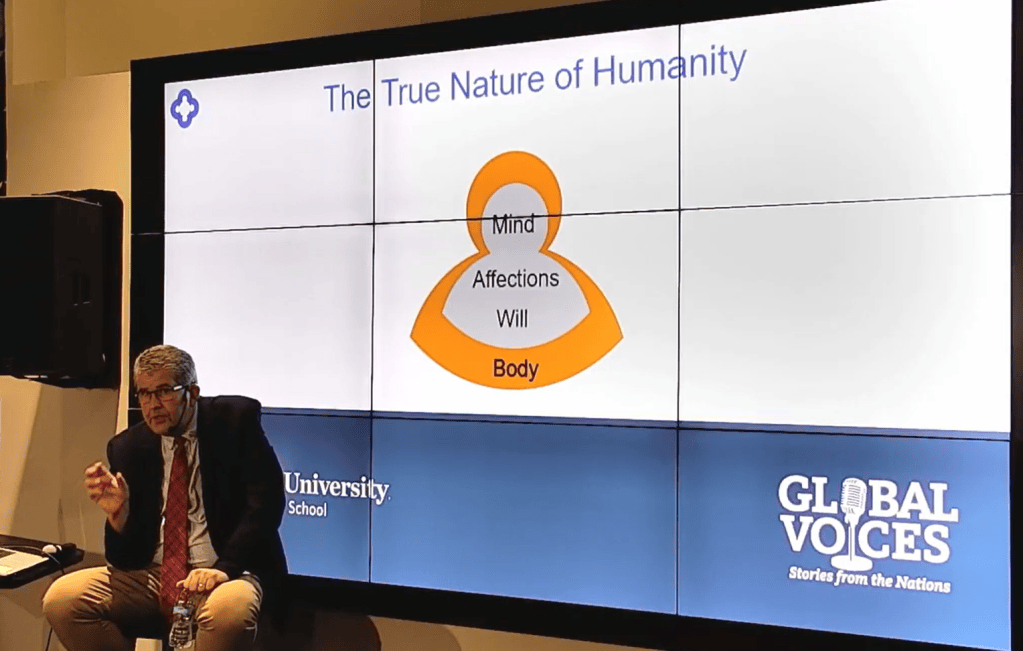
    Dr. Brian Fikkert, director of the Chalmers Center at Covenant College, has had an incredible impact on the world of missions by helping people think through the difficult and ubiquitous issues surrounding money, missions, and giving to the poor. When Helping Hurts, which Dr. Fikkert co-authored, has become a classic must-read book in the world of missions. Last year we were privileged to have him as a guest in the Global Center to discuss his most recent book, Becoming Whole.

    On a personal note, Brian was a blast to hang out with. He’s engaging, shows genuine interest in people, and has a quick wit. Fun fact: He’s 6’10”

  • When Love for All Made Jesus Angry at a Few

    When Love for All Made Jesus Angry at a Few

    Perhaps there’s no story in scripture so often used to justify our self-righteousness as Jesus clearing the Temple. It’s a favorite for every Christian with an anger management problem. I once had a tennis coach who wanted me to be more angry with my opponents. He always knew how to press my buttons. He looked at me and said, “Even Jesus kicked people out of the temple.” As usual, he left me speechless, since my hermeneutical skills weren’t all that quick as a Sophomore.

            It’s easy to judge the misuse of passages like this, but stay in ministry long enough, deal with the “do-nothing, self-appointed critics” long enough, and at some point you’ll eventually find yourself lingering on this passage, and wrestling with proper exegesis. Maybe I should throw his pew into the foyer. That’s what Jesus would do.

    This article is from a 2020 sermon at Beeson Divinity School. Starts at 6:36

            This story is also used to justify our tribalistic outbursts toward others on the wrong side of the political aisle, which is ironic when we really look into what Jesus is doing here.

            It’s used in good ways as well. As a matter of fact, you could legitimately focus on one of several major themes that emerge in the passage. Spoiler alert, I’m going to talk about missions. You didn’t see THAT coming.

            It’s easy to get the impression that Jesus just walks into the Temple and is not only shocked by what he saw, but that he’s surprised. And that would make us think that what he did was sort of a reactionary and unplanned outburst where perhaps he wasn’t in total control of himself. But Mark points out in verse 11 that he had already entered Jerusalem and gone into the Temple the day before. It was after first entering the temple, and before the cleansing of the Temple, that he cursed the fig tree – a story that we can’t possibly understand without considering the context. He was preparing the disciples with a metaphor to understand what was about to happen. Essentially, he’s saying that that the Temple and its religious leaders are just like the fig tree in that it’s no longer performing its function. It had the appearance of life, but no figs. The religious leaders and the Temple religion they led also was not bearing fruit and it was time for a revolution.

            It was both common and necessary for the Jewish leaders to provide for the needs of worshipers who’ve traveled from great distances. They would need to have their Roman money exchanged for the local currency so they could pay the temple tax. They would need to have the option of purchasing animals for sacrifice in Jerusalem. What if your animal reaches the destination without any problems, but they decide that it doesn’t meet the kosher requirements? What would happen if you brought a spotless sheep that was attacked by a wolf on the way? And it couldn’t be very easy to bring a live pigeon on a three week journey. The problem wasn’t that they were doing these things. As they say, the devil’s in the details. It wasn’t necessarily what they did. It was how and where they did it. I can tell you from experience, and so can many of you, that’s it’s extremely frustrating to enter a new country and get stuck with no option for currency exchange except one place that’s ripping you off with unfair rates. So the money changers, who have a captive audience inside the temple, are charging exorbitant prices for the exchange and those who sold pigeons are doing the same thing. And not only should they be providing these services for fair rates, but they shouldn’t be doing this inside the Temple at all!

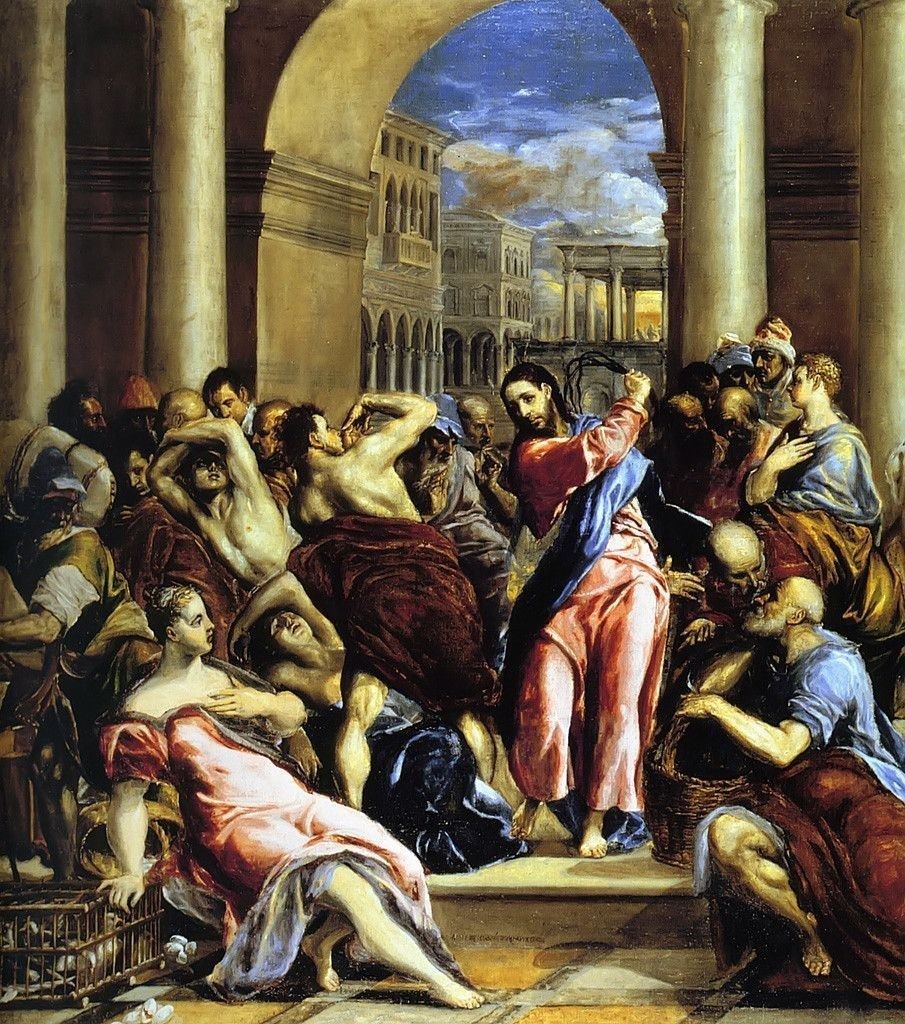
            Jesus smells the stench of the animals, hears the exchange of coins (again!), sees the crowded lines and others who are apparently just walking through carrying things as if it’s nothing more than a thoroughfare. and he’s incensed that this sacred space, the center of worship for Yahweh, has basically been turned into a bazaar. Who could concentrate to pray in such an atmosphere?! So Jesus drives out those who sold and those who bought in the Temple. He overturns the tables of the money changers and the seats of those who sold pigeons. John adds the fun detail that he took a whip of cords to help accomplish the task. Don’t you just wish we had this on video?!?! To see exactly how he did all of this. Were the pigeon sellers sitting in their seats when he overturned them? Did the whip actually make contact with anyone? I grew up on Indiana Jones, so there’s a big part of me that hopes it did. Can you imagine the stunned faces throughout the temple? The commotion outside of the temple as word spread and everyone knew Jesus had slapped the Chief Priests in the face with his actions. Because it was they who were in charge of all of this. Mark points out that the “chief priests and the scribes heard it and were seeking a way to destroy him, for they feared him, because all the crowd was astonished at his teaching.” And apparently, after clearing the area, Jesus stuck around afterward to teach all day, since Mark ends with “And when evening came, they went out of the city.

            To explain why he was doing what he did, Jesus quoted Isaiah and Jeremiah, saying, “Is it not written, ‘my house shall be a house of prayer for all the nations,’ but you have turned it into a ‘den of robbers.’” Centuries before, God commanded Jeremiah (as recorded in chapter 7) to go and stand in the gate of the temple and convict the people of their sin. He told him to say, “Do not trust in these deceptive words, ‘this is the Temple of the Lord, the Temple of the Lord, the Temple of the Lord.” These words had become a sort of incantation, as if they could conjure up power for themselves by claiming that God is on our side, regardless of whether or not they actually followed his commands. They claimed his promises of protection without heeding his warnings for disobedience. Jeremiah told them to repent, and do justice. Stop committing adultery. Stop going after other gods. Don’t oppress the fatherless, the widow, or the sojourner. Or he would do to the temple as he did to Shiloh, where the other house of God, the tabernacle, was housed. They were thinking of the temple as they once thought of the ark of the covenant – a weapon to be wielded, with no real attachment to a covenant with the living God. So “den of robbers” was a reference to bandits who would take part in evil activities, hide in the hills for awhile, and then take refuge in the Temple – never feeling the need to repent of their actions since no one there would convict them.

            What we see in this story, as well as the accounts in the other gospels, is Jesus insisting that worshiping God is not simply about offering a sacrifice, being blessed by God, and living however you want. He is a holy God to be held in awe. He will not be mocked – not even by the Chief priests, who let the worship of Yahweh devolve into nothing more than a corrupt tourist attraction.

            The Jewish leaders were not awed by the presence of the Lord in the holy of holies. Like those in the time of Jeremiah, they believed the temple was simply proof that God was on their side. I could stop here and elaborate on the truths that emerge in all of the synoptic gospels, but there’s one little phrase, included only in Mark, that shouts at us from this passage.

            A house of prayer… FOR ALL THE NATIONS

            Matthew and Luke leave off “for all the nations,” but all three record Jesus quoting Isaiah 56:7. Let’s read 56:6-8 for a little more context.

    “And the foreigners who join themselves to the Lord, to minister to him, to love the name of the Lord, and to be his servants, everyone who keeps the Sabbath and does not profane it, and holds fast my covenant— these I will bring to my holy mountain, and make them joyful in my house of prayer; their burnt offerings and their sacrifices will be accepted on my altar; for my house shall be called a house of prayer for all peoples.”  The Lord God, who gathers the outcasts of Israel, declares, “I will gather yet others to him besides those already gathered.”

            And yet the one place they had to go in Herod’s temple, the Court of the Gentiles, has now been turned into a distraction. All in all, there are multiple tragedies occurring here. A lack of reverence for the worship of Yahweh is the obvious one. Another is that the Gentiles have nowhere to pray. They’re cut off. They have no access to the rest of the temple, as Jews do. But when the people of God get caught up in “business as usual,” they tend to lose their concern for outsiders. Imagine how you would feel if you were a Gentile worshiper and you traveled for weeks, anticipating an authentic experience of worshiping the God who created the universe, only to arrive and be ripped off, inside the temple, and then have to try to concentrate to pray with people standing in different lines, the sound of money exchange (and I wonder if there were arguments about the exchange rates!), the sight, sound, and smell of animals, and others just walking through carrying things from one place to another? They thought they were coming to this sacred place for a holy experience, only to be disillusioned with what must have appeared like a glorified fundraiser.

            Like the fig tree, Jesus pronounced the temple as dead. It’s no longer achieving its purpose. It’s now time to transition from the temple to a person. I believe that, in this story, we see the holiness of God and the purposes of God collide. And we see an explosion in the heart of Jesus for both. The holiness of God, and the purposes of God.

            We can see that Jesus clearly understands the present in light of history. And since he’s the second person of the Trinity, we also know he can see into the future. So… what else, besides Jeremiah and Isaiah, might he have been thinking about as chairs and tables crashed to the ground??

            Was he thinking about Abraham’s call to be a blessing to all families of the earth? Could he hear the echoes of Solomon’s prayer during the inauguration of the first temple, when he petitioned God to hear the prayers of foreigners who would visit that holy place? Was he burning with Israel’s call to be a kingdom of priests and a holy nation, in order to glorify God among the nations? Could he feel the rhythms of the song of the psalmist asking God to bless them and keep them, SO THAT His way would be known on earth; His salvation among all nations?

            Yes, it’s true that Jesus’ ministry was focused on Israel, but the coming day, when the movement would no longer be centripetal toward Jerusalem, but instead would be centrifugal – outward and to the ends of the earth – is a consistent theme in the gospels and even shows up in Luke 2, when Jesus arrives to the temple to have Simeon take him up in his arms and say, “I can now die in peace, for my eyes have seen your salvation that you have prepared in the presence of all peoples, a light for revelation to the Gentiles, and for glory to your people Israel.”

            It’s so interesting that the temple is a constant point of contention in the gospels. Jesus confronts a practice of swearing on the gold of the temple, making the point that surely the temple itself is more important than the gold. And there was the day when his disciples, most of them from small towns, are in awe over the temple and the buildings, prompting Jesus to tell them to take a good look at it again – and that there wouldn’t be a single stone left on top of the other in the future. Not the reaction they expected, and I’m guessing they were really curious about this. What does Jesus have against the temple?? And what does he mean when he insists, “Something greater than the temple is here?”

            The longest recorded conversation of Jesus is with a Gentile woman, from Samaria. When Jesus reveals that he has supernatural insight into her life, specifically, her sins, she switches the topic to a theological debate between Jews and Samaritans. Where are we supposed to worship? This mountain in Samaria or in Jerusalem. i.e. the temple in Jerusalem. And Jesus grants her the extraordinary privilege of being told that a time is coming when it won’t matter where you are.

            Jesus told the Jews, “tear down this temple and I will raise it again in three days,” knowing they would be angry at the statement. Today we quickly rush to the interpretation that he was talking about his body, as if the Jewish leaders would have been less offended if they had only understood that. Saying he could rebuild the physical structure of the temple seemed ludicrous and offensive, in their eyes. Equating his body with the Temple? That was blasphemy on a completely different level.

            As Jesus is showing the buyers and sellers the exit, he fully understands that he was the Lamb of God. The ultimate sacrifice which would forever nullify the practice of animal sacrifice. The Holy of Holies, only meters from him, would no longer be necessary. And when he died on the cross, we are told that the temple curtain was torn from top to bottom. I can’t say this for sure, but I believe this is when the gravity of God’s relationship with humanity began its shift from a centripetal force, drawing people to worship in Jerusalem, to an outward centrifugal force, with the Spirit of God being unleashed to every corner of the earth, as his followers – little temples of the Holy Spirit – are scattered throughout the world.

            In Acts, the temple remains a center of conflict as the gospel, with its lack of emphasis on following the Mosaic law, successfully enters the hearts and lives of Gentiles. Stephen, after being accused of blasphemy against the temple, launches into a long sermon about the history of God’s relationship with Israel. Toward the end he acknowledges that Solomon built a house, but the “Most High does not dwell in houses built by human hands,” leading to his execution. His murderers laid their coats at the feet of a young man named Saul, who would have such a radical conversion that he would later teach the Ephesians that they – THEMSELVES – were being built into a holy… TEMPLE… with No. Dividing. Wall. Between Jews and Gentiles. In the new temple, the Gentiles would not be crowded out by people buying and selling.

            Paul himself would eventually be arrested for speaking against the law “and that holy place,” and for allegedly bringing a Gentile into the temple. A temple that would be destroyed not longer afterward.  And we know that Jesus was aware that one day there would be people from every tongue, tribe, and nation worshiping God in the New Creation.

            Transition: Jesus knows all of this, past, present, and future, as he cleanses the temple. He’s ripping the disciples’ faith away from a nationalistic understanding of the Temple so that, among other things, he can later give them the Great Commission and they can have full confidence that the word of God can spread to every corner of the earth with no need to return to Jerusalem.

            He knows all of this, so in his immediate situation… back to the passage here… he identifies the problem and removes the barriers. He identifies the problem and removes the barriers. He clears a path, if you will, for those who came seeking the Author of Truth. And this is an example for the church to follow. Because when we let worship become “business as usual,” we tend to focus on ourselves and be unconcerned about the barriers to the gospel experienced by those not like us.

            The history of the expansion of Christianity is full of people identifying and removing barriers to the gospel. William Carey challenged a hyper-Calvinism that can be summed up in the words of a man who opposed his missions plans: “Young man, sit down. If God wants to save the heathen, he’ll do so without your or my help.” So he argued that God uses means, I.e. the efforts of men and women, to move the gospel forward. In an age where many taught that the apostles had completed the great commission, he used research and statistics to prove that this was very much not the case.

            Like William Carey, Hudson Taylor also had to overcome a negative witness from British colonialists who claimed the name of Christ. Their belief that they were inherently superior proved to be a significant barrier to the Chinese receiving Christ. So he humbled himself, learned their language and culture well, served them through medicine, and dressed as one of them as a way to show them honor. While other missionaries were content to remain on the coastlands, where it was closer to the British navy and, therefore, safer, Hudson Taylor took the radical step to move the gospel inland to where the majority of the people actually lived. He was told it was reckless, both for him and those he took with him, but he countered with the biblical truths that risk is common with the propagation of the gospel.

            Eliza Davis George, an African-American missionary, also went beyond the false barrier of the coastlands into the interior of Liberia in 1914. She’d had a vision of Africans standing in front of the judgment throne saying, “No one told us you died for us.” So she opened a school, taught the gospel, and mentored young people to take the message to their own people.

            And in 1974, just when Christians were beginning to become satisfied that Christianity could be found in virtually all nation states, Ralph Winter stepped to the podium at the Lausanne Congress and revealed that they had “people blindness.” That there were untold millions of people from ethnic backgrounds who did not have anyone to share the gospel with them in their language, even though they lived in a country where Christians existed. But in reality, they had – AND MOST STILL HAVE – no access. No churches. No Christian friends. And it’s not just unreached people groups. There are cities across Asia, in particular, with ten million plus people, where the ethnolinguistic lines aren’t clear cut, most of us haven’t even heard of them, and there is only a smattering of Christian witness.

            In my present position, it’s my privilege to oversee the Cross-Cultural Ministry Practicum and help students see what it means to identify and remove the barriers to the gospel. A couple of our students went to Oman, where they got into a conversation with a man who, when finding out they were Christians, asked them, “What do you think about the Holy Spirit?” They eventually found that he’d been seeking a Bible he could actually read. The government had blocked Bibles from the internet. The only Bible he had access to what the Arabic equivalent of Shakespearen English that meant nothing to him. So our students were able to hand him a modern Arabic translation and were stunned to realize that someone in a modern country, not in a remote jungle, literally didn’t have access to the gospel. They marveled over what a privilege it was to complete the simple act of handing them Bible. It was the end result of God working through other missionaries, the ones who hosted them, to identify the problem of gospel access and remove the barriers by leaving everything behind and taking a risk.

            Quite a few of our students have had the privilege of joining Chris and Mary Granberry in Washington state, who have ministered and planted a church among the Yakama people. Can you imagine what would be like to move there knowing the incredible baggage that exists from all of the evil inflicted on Native Americans by those who claim the name of Christ? So they committed to be there for the long haul, serving the people in many different ways, humbling themselves to learn the culture and listen to them, and building relationships along the way. It took years for them to make a crack in the barriers of a poor Christian witness, but eventually they were able to plant a church on a reservation that, quite frankly, is full of people in desperate situations.

            The task of global disciple making is far from finished. The Joshua Project estimates that approximately 3.2 billion people are in unreached people groups, with either no access to or a distorted knowledge of Jesus. And only 10 percent of evangelical missionaries are working with them. As I teach these things in class, I’m careful not to use guilt or coercion to motivate people to go cross-culturally. Such tactics hurt everyone involved, eventually. And I consistently affirm that “not all are called to go” into another culture. But I want to point out something I’ve noticed over the years. Yes, it’s true that there are certain pockets of evangelical Christianity that act as if the only committed Christians are those who go. They don’t understand the goodness of how God calls most to stay and do things such as open a business. But there are other pockets whose only response to this is, “not everyone is called to go. There are many types of vocational callings.” And that’s all they ever seem to say. I just want to suggest today that this just isn’t enough.

            Before we land on “not everyone is called,” we need to admit… not everyone’s going! The way some people talk, you’d think that half of all evangelical Christians had packed up and gone to the 10/40 window. Or that the majority of seminary graduates were leaving the country. If you had to guess, what percentage of Beeson graduates do you think have gone into cross-cultural ministry for at least a few years of their career? Our best count is 4%. Now, my guess is that this percentage compares well to other seminaries, but I don’t know that for sure. What I do know is that there certainly isn’t a problem with too many people going to the unreached. Personally, I’m praying that one day soon, we would be closer to 10%. A tithe to the nations would surely be pleasing to the Lord.

            I’m a member of a denomination that prides itself on its commitment to the Great Commission. And I’ve heard many people push back on certain leaders, saying, “But what about America? We’re lost, too.” I have an enormous burden for my country as well. And let me be clear. There are significant pockets of our country that qualify for most missiologists’ definition of an unreached people group. Just not in the South. But two simple statistics clarify the reality of whether or not too much emphasis is given to missions. The missions agency of the SBC is the International Mission Board. They have a total of 3,613 IMB missionaries. There are 14.5 million Southern Baptists. That’s .025 percent. Let’s add in the North American Mission Board and give a very generous estimate of SBC missionaries with other agencies and say it adds up to .1 percent. Does this amount to a problem of too many people going? As we’re teaching our congregations that whatever God calls you to is good, and that you don’t have to be a missionary, shouldn’t we also teach them that, relative to 3.2 billion in unreached people groups, massive cities across the world with few Christians, and youth growing up in a very different world than their parents…. relatively few people are going?

            They should also know that most missionaries are sent to places that are already reached. Having said that, I heartily affirm the sending of competent leaders, trained both biblically and culturally, to go to the places, such as Latin America and Africa, where the church has grown rapidly, but they are cut off from solid biblical training. They’re left vulnerable to heresy, and abusive prosperity gospel preachers. I’ve heard of young pastors being taught to just preach on whatever you dream the night before. In a land where we’re stacking up PhDs to the point where teaching jobs are scarce, the opportunities to train pastors globally are endless. It’s my prayer, and that of Dean Sweeney as well, that Beeson can play a greater part in this.

            There’s another pushback to getting involved with the nations that says, “We need to do missions in our community first.” I’ll just give two observations. First of all, I sympathize with churches and leaders from communities in great need – ESPECIALLY in the age of covid-19. When all of this began, it was my first instinct to pray for and give to some of these communities. However, when churches say “community first,” it means “the nations never” – because the needs in any community are endless. The other observation is that “community first” usually means “people who look just like us.” It rarely includes people from other cultural and ethnic backgrounds who live in the area. Most of us have opportunities to reach out those around us who are different – black, white, hispanic, and other – if we’d just look. And there are people from unreached people groups here in Birmingham. Will you identify the barriers and make a path?

            I began the sermon by saying it was ironic that some use this story to justify their anger toward those on the other side of the political aisle. As we look into the application of following the example of Jesus, we ALSO need to make sure we’re not the ones diminishing the glory of God among non-Christians. And the way we publicly engage in politics, it’s not hard to picture Jesus escorting us out of the way. It’s hard for people to see who Jesus really is when all they observe is that we hate Democrats. Or Republicans.

              But I can confidently say that, even with a pandemic, even with racial injustice, even with rioting, even with the insanity of election season, and all the ways things could go even more wrong… we can and should place an emphasis on the Great Commission and clearing a path to and for the unreached. It’s not either my community or global missions. It’s both/and.

              Since most people here and those who are watching are either ministers or future ministers, I want to conclude with a plea geared toward you. First of all, perhaps while you were listening, your heart began to burn with a longing to be sent out into another culture. Write it down when you get a chance. Tell God you will go wherever and do whatever he wants. Perhaps he’s calling you to go. Sometimes we just need to be asked. So I’m asking. Will you go if he’s calling?

              Or maybe he’s cultivating a heart for those who are cut off from the gospel to prepare you for leadership in a local church. Will you commit to leading your church on mission, both locally and globally. Will you commit to pointing out the barriers in your community? In the nation? In the world? For those of you who say that you want to be senders, great! Are you sending? Will you ask them to go?

              On the cross, Jesus completed the task of clearing a path for the nations to worship him, in Spirit and in truth. May we walk in it until the day when all things are made new and the entire world is, in fact, a house of prayer for all nations. Amen.