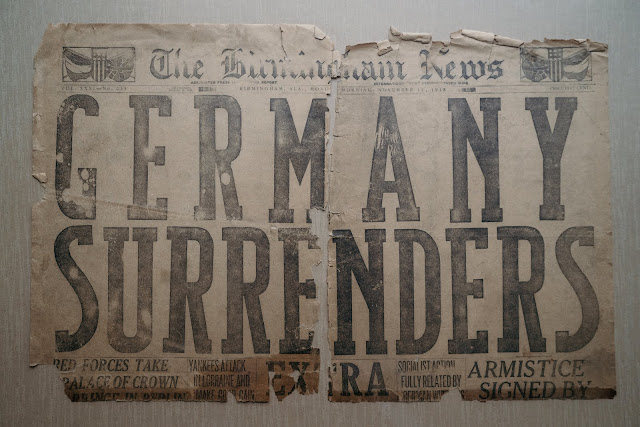
My favorite feature of my grandfather’s house in the East Lake section of Birmingham, Alabama was his upstairs closet. It tunneled from a master bedroom and emptied into a stairwell. When the adults weren’t looking, we’d wade through the clothes, boxes, and a small Christmas tree to find our way to the other side. What no one knew – except my grandfather, I presume – is that somewhere in one of his closets lay a stack of historic newspapers. “U.S. Mourns Slain President” and “Man Walks on the Moon,” both from the now-extinct Birmingham Post Herald, splashed the headlines as they emerged from an old dusty box.
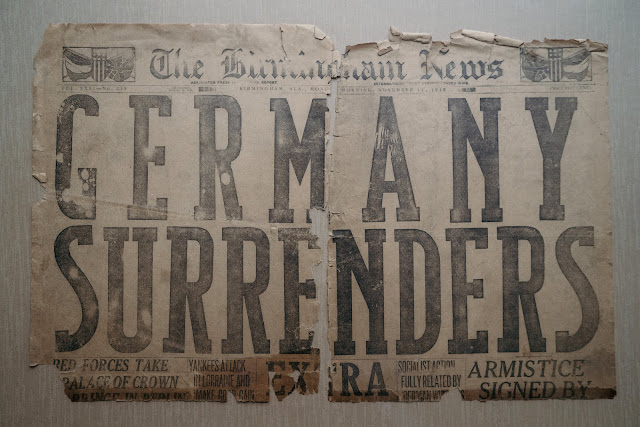
The most striking headline, on an edition of The Birmingham News, reads “GERMANY SURRENDERS!” The date? November 11, 1918. It was discovered after my grandfather died and my Mom decided to ask the history major (i.e. me) if I wanted to have it. My wife had it framed over 17 years ago and I now have it proudly displayed in my office. For years I’ve imagined the fun I would have showing it off to the world when the 100-year anniversary came around, but over this past Summer I realized there was a real problem with how I had envisioned this.
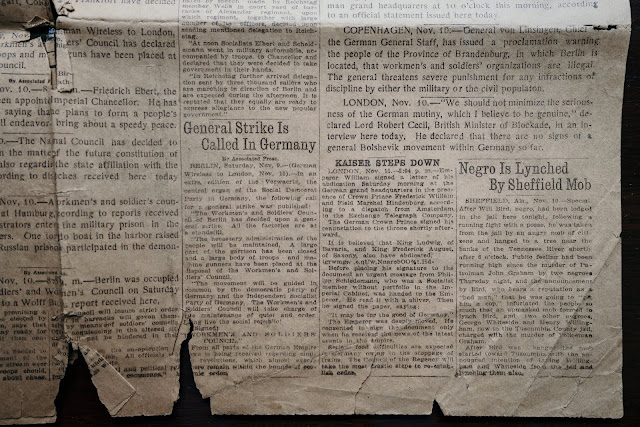
Only the top of the front page is framed. The bottom half is not, and on the lower right side of the front page is a short but horrific article entitled, “Negro Lynched in Sheffield.” On November 10, 1918, after a policeman had been murdered, a mob took out their frustrations on a black man named Will Bird. He was not being accused of the crime (two other black men were being held in jail on suspicion), but since he had the reputation of being a “bad man” and had reportedly said he was “gonna get myself a cop,” the angry mob accepted rumor as fact and made themselves judge, jury, and executioner.
As much as I want to unabashedly celebrate the courage of my American ancestors, I don’t want dishonor my black brothers and sisters in Christ by neatly, and quite literally, eliminating our not-so-courageous history from the front page in the process. On the surface, you might say that this is obvious, but on further analysis, the reality is that our political tribalism actually makes it difficult to place competing narratives on the “front pages” of our discussions. For example, some of those in my tribe of conservatives will celebrate the USS Arizona Memorial because we need to make sure we “never forget,” but when slavery and lynchings are discussed, they respond with, “Why bring up the past?” Christians who are more on the liberal Democrat side, however, love to talk about the oppressed, but don’t want to talk about abortion even if they think it’s wrong.
It seems to me that American Christians tend to choose from one of two faulty understandings of history: the liberal Democrat view and the conservative Republican view. Each side has a fairly clear narrative – reinforced daily through talk radio, cable news, and the echo chamber of our social media feeds – all of which insist that certain topics remain prominent while others are pushed to the back pages. Together they shape and reinforce a worldview that determines how they respond to any given issue. For the Christian, the common fault of both of these narratives is that they both focus exclusively on the history and current issues of our country alone. In my Introduction to Christian Missions class, I teach our students to understand a person’s worldview, not simply through the religious label they give themselves (Hindu, Muslims, etc.), but by finding out what they believe about the some of great questions of life. How did we get here? What went wrong? How can it be fixed? What happens when we die? In the process, you may discover that the person who claims to be a Hindu is really more of an atheist and that, when they say “I’m Hindu,” it’s more of a cultural identity than religious statement. When we use these questions to analyze what American Christians are actually talking about and listening to on a day to day basis, however, two insidious narratives emerge which are very different from the Bible’s history of salvation.

To be sure, the above chart is simplified and limited in scope, but it illustrates the everyday narratives that reinforce our view of politics. To demonstrate the importance they serve in public discourse, look at what happens when one side contradicts the other’s view of The Fall. When a conservative Republican talks about the uniqueness of the American Constitution (or anything positive about the Founding Fathers), there will often be met with a swift and sharp critique from the other side that points to slavery. The assumption is that, since slavery existed, nothing from the entire era of history can be celebrated nor should it be emulated. On the other hand, bring up Thomas Jefferson’s edited Bible and you may be met with a flurry of objections from conservatives, whose worldview depends on early America consisting purely of pious, Bible-believing Christians faithfully attending church. Even though we needed two Great Awakenings in less than a century – one just before our country’s independence and one directly afterward – because of waning church attendance, deism, and general skepticism leftover from the Enlightenment (not to mention the existence of the evil of slavery!), this narrative persists. And why are the reactions so sharp from both sides? It’s simple. The foundation for all of our beliefs and actions have been threatened.
For the Christian, this shouldn’t be the case. We have the word of God with its sure foundation and beautiful narrative sufficient for all of life – including politics – for people from every tongue, tribe, and nation on earth. In Genesis 1 we see that, while the United States was not perfect in origin, our beautiful world was. The first human beings were created in the image of God and placed lovingly in a garden. Our problems began, not with the transcontinental slave trade, but when Adam and Eve sinned and the hearts of all subsequent generations were radically corrupted. It marred the image of their Maker and enabled every form of evil and wickedness known to human beings. God, however, did not give up on us. He called Abraham and promised that he would give him a new land, that he would become the father of a great nation, and that, through him, all families of the earth will be blessed (Genesis 12:1-3). His descendants eventually entered this Promised Land and were given clear instructions on how to glorify God and be a witness to the nations, but the evil within them prevented this from happening (Deut. 4:5-8, Romans 2:17-24). Instead, the people of Israel mistook responsibility for privilege and became centered on themselves, abandoning God’s law time and again. In his great mercy, God sent prophets to tell them to repent and to warn of impending judgment if they don’t. God led Jeremiah to prophesy that one day his law would not simply be external commands, but written on their hearts (Jeremiah 33:14-16). Isaiah predicted a suffering servant, by whose stripes we would be healed, would come to save us from our sins. Then the miracle. Jesus came to us, the word made flesh, to show us how to live and to die for our transgressions. He rose from the dead, demonstrating his power over sin and guaranteeing our own resurrection, then commanded his followers to make disciples of all the nations. After he ascended to Heaven, his followers were filled with the Holy Spirit and preached the gospel to those in Jerusalem, Judea, Samaria, and began the process of spreading his word to the ends of the earth, especially through the ministry of Paul. The Bible ends with a beautiful picture of people from all tongues, tribes, and nations worshipping God around the throne just like Jesus predicted. (Matthew 24:14, Rev. 7:9-10). But the goal of history can’t be reduced to diversity. Revelation also speaks of the fall of Babylon the Great, who is said to have corrupted the world with its sexual immorality (Rev. 18:1-10). In the Bible, holiness and inclusion are not enemies.
Since the time of the early church, the gospel of Jesus Christ has slowly made its way to the ends of the earth, even to far away countries like China and still other places that no one even knew would one day exist – like America. Sometimes it happened through the scattering and persecution of believers and sometimes through the obedience of missionaries following the call of Jesus to cross national and cultural boundaries. Today the center of gravity for the Christian faith is no longer in the West. It’s in what we call the Global South – in areas of the world below the equator, especially in Africa and parts of Asia. While many Christians in the West lament the decline of Christian influence in our culture (a tragedy over which to grieve, to be sure) we completely miss how dramatically God is still working today. Not only has the percentage of evangelical Christians remained strong in America, but more Muslims across the globe have become Christians since 9/11 than at any point in history! This is good news for Christians in a nation where we are continually warned by both sides that the end of everything good in the world is near.
Until Jesus returns, Christians can confidently risk honesty about the leaders and movements who represent “our side.” This is true both because we have confidence that God is in control and because our primary responsibilty isn’t fidelity to a political party. It’s faithfulness to Jesus and his beautiful gospel. I will be the first to admit that finding a balance is very confusing, and I’m certainly not advocating that we incessantly post political messages on social media, but we must try to find ways to honor the Lord in the mess that our political discourse has become. Can Republican Christians admit when our President has done or said something that contradicts Scripture or must we defend him at all cost because the next election must be won? Can Democrat Christians admit when he’s done something good or must he always be portrayed as pure evil because the next election must be won? Can we affirm the courageous self-sacrifice of the majority our police force and at the same time admit there are significant problems with bias against minorities? If we continue to cut and paste, not only will we dishonor Jesus Christ, who is the way, the TRUTH, and the life – but we also will fail to be a witness to the gospel in a world that is lost and in desperate need of Jesus.
The conservative Republican view only wants to see the top half of my newspaper. The liberal Democrat view only wants to see the bottom. Both are operating on the assumption that our only hope will be found in a political solution. Neither can see anything of eternal weight beyond our own borders or our own country’s history. Not only does a biblical worldview have room for both halves of the paper, but it even has leftover space for a breathtaking headline of hope.
“JESUS IS COMING!”
 David Parks
Leave a comment